
What is the best tool for an independent bar or restaurant in 2026?
By Samuel Carrillo6 min read
A salesperson called. They showed you a screen full of charts and said you would finally know how much you make on each dish.
You signed. You logged in three times in January, once in February, and since then you pay every month for something you never open.
It isn't your fault. And the numbers explain pretty well why it happens.
How much does each tool cost per year?
Prices published by the companies themselves, excluding VAT.
| Tool | Annual cost |
|---|---|
| Tipi | €39/month + €139 setup = €607 |
| Haddock (Basic) | €159/month = €1,908 |
| tspoonlab (Back + Fast) | €205/month = €2,460 |
| Yurest | Does not publish a price |
None of those figures, except ours, includes setup.
The fee that exists but has no price
On its pricing page, Haddock has a section for the "Custom implementation fee for you with every plan". They acknowledge the setup cost. What they do not say is how much.
Getting one of these tools live takes between 20 and 40 hours of entering suppliers, items, prices and recipes, and that work has to be paid somehow: either you do it, or they charge you.
So when you ask for a quote, the first question is always the same: how much is the implementation fee? It rarely comes with the monthly price.
tspoonlab's "from €95" does not include cost control
tspoonlab advertises its Professional plan from €95 a month. That plan digitises delivery notes; purchasing, inventory, waste and dish cost sit in tspoonFast: €110 more a month. Real cost control: €205 a month (our reading of the feature split on their site).
The minimum revenue for the tool to pay for itself
Food cost: of every 10 € on the plate, what the ingredients cost. If that was 3.30 €, it is 33%.
Cutting one point of food cost saves you 1% of what you turn over. If you do 300,000 €, that is 3,000 € a year. Divide annual cost by that 1% and you will know if it pays off.
| Tool | Minimum revenue |
|---|---|
| Tipi | €60,700 |
| Haddock (Basic) | €190,800 |
| tspoonlab (Back + Fast) | €246,000 |
(Our calculation: annual cost divided by 1% of revenue. Tipi’s figure includes our setup fee; the other two do not include the implementation fee, which is not public, so their real minimum will be a bit higher.)
In plain terms: if your bar turns over €200,000, both tspoonlab plans to cut one point lose you money. Not because it is a bad tool: it is not built for your size.
Which tool suits whom?
Haddock, tspoonlab and Yurest charge for modules that exist and work (documents, production, staff, finance). The question is not whether they are worth the price, but whether you need them. If a more powerful tool drops you two points instead of one, the maths flips.
tspoonlab: production kitchen, very elaborate menu or traceability.
Yurest: several sites and centralised purchasing, staff and finance.
Haddock: heavy invoice volume, bank reconciliation and supplier variance.
Tipi: yes, that is us. For the owner who cooks or works the bar: dictate the recipe, photograph the delivery note, no integrations. €39 a month, plus a one-off €139 setup fee. First year 607 €; then 468 €; annual 420 €.
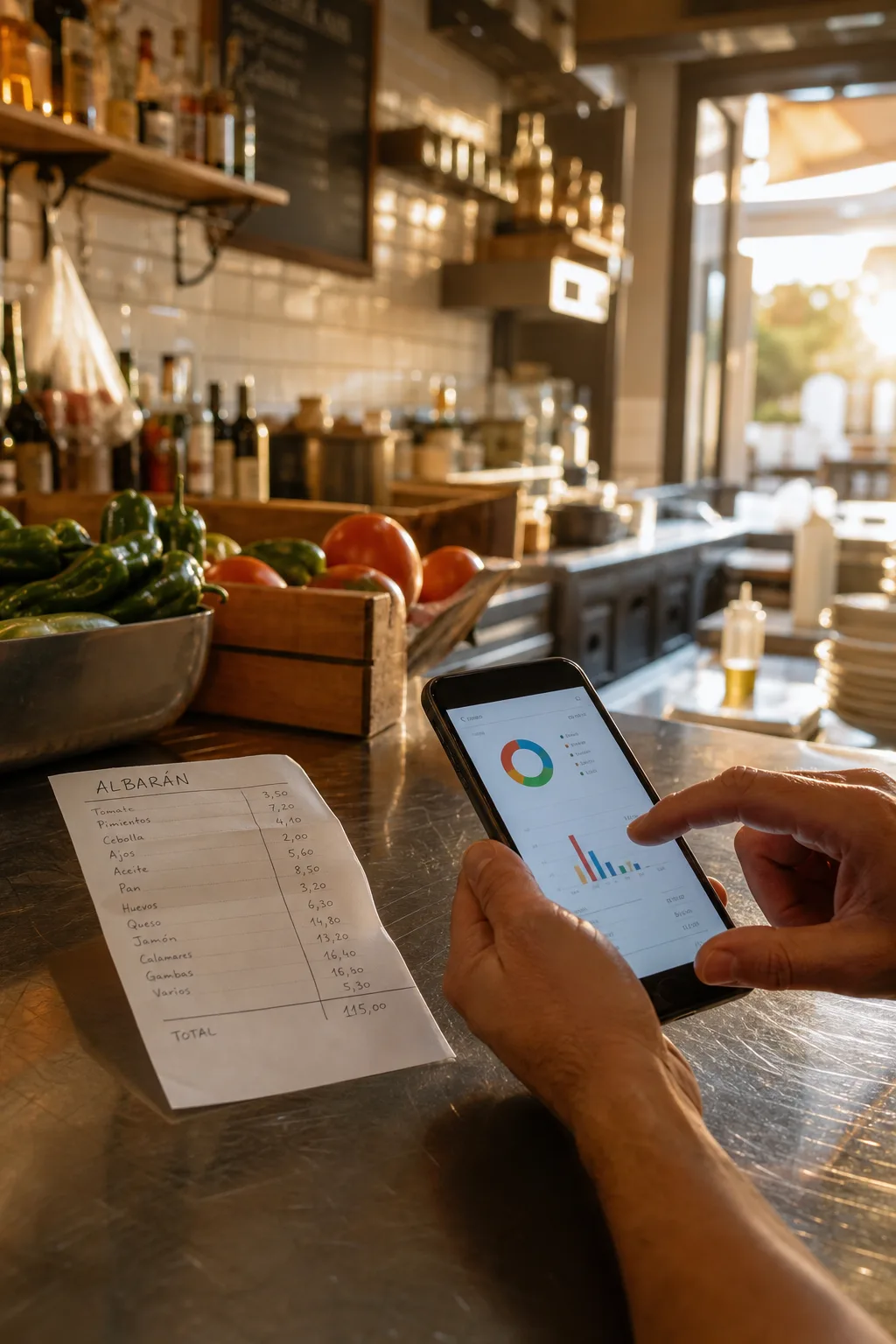
This is Tipi on a phone: recipe book, photograph the delivery note, supplier spend, and month-end inventory.
That approach is what won the award on 17 February 2026 at HIP – Horeca Professional Expo (IFEMA Madrid), where Tipi won the Future Gastronomy Startup Forum from GOe – Gastronomy Open Ecosystem and Basque Culinary Center. Honest detail: that prize does not come with money.
We are not the best fit with a central kitchen, more than three sites, or if you want a POS.
How to choose a tool without signing blind
- Take your annual revenue and multiply it by 0.01. That is your realistic saving from cutting one point. Any annual cost above that figure is money lost.
- Look at the last receipt for the software you already have. If you have not logged in this month, you already have your answer.
- Cost your five best-selling dishes. Just five, by hand if you must.
- When you ask for a quote, three questions: how much is the implementation fee? Which modules do you need for cost control? How many of my hours until this actually helps me?
Unpublished prices, onboarding fees and what Tipi doesn't do
- Yurest does not publish a price, so we cannot put it in the tables. If they send you a quote, run the division yourself.
- Implementation fees are not public for any of the three. We know Haddock charges one because it says so on its site; the amount, no.
- Prices change. These are the ones published as of 4 August 2026. Haddock specifies that theirs exclude VAT.
- The reading of tspoonlab’s two plans is ours, deduced from the feature split published on their site.
- What Tipi does not do yet: supplier orders, goods receiving, production orders and batch traceability. It is on the roadmap, with no public date. Do not buy today counting on it.
If the venue turns over well and nothing is left at month-end, and you cannot see where it leaks, tell us your revenue and we will run the minimum-billing maths with you: the one nobody does in the demo.
Does your tool pay for itself at your revenue?
Tell us what your venue turns over and we will help you see if Tipi fits, or if something else suits you better.
Sources
- HIP – Horeca Professional Expo, Future Gastronomy Startup Forum
- GOe – Gastronomy Open Ecosystem, Basque Culinary Center
- InfoHoreca, UVE Data Market Horeca 2025 report
- Public pricing pages for Haddock, tspoonlab and Yurest (checked 4 August 2026)
- Hostelería de España, Spanish Hospitality Yearbook