
Why hospitality is so slow to digitize (even after you accepted the POS)
By Samuel Carrillo8 min read
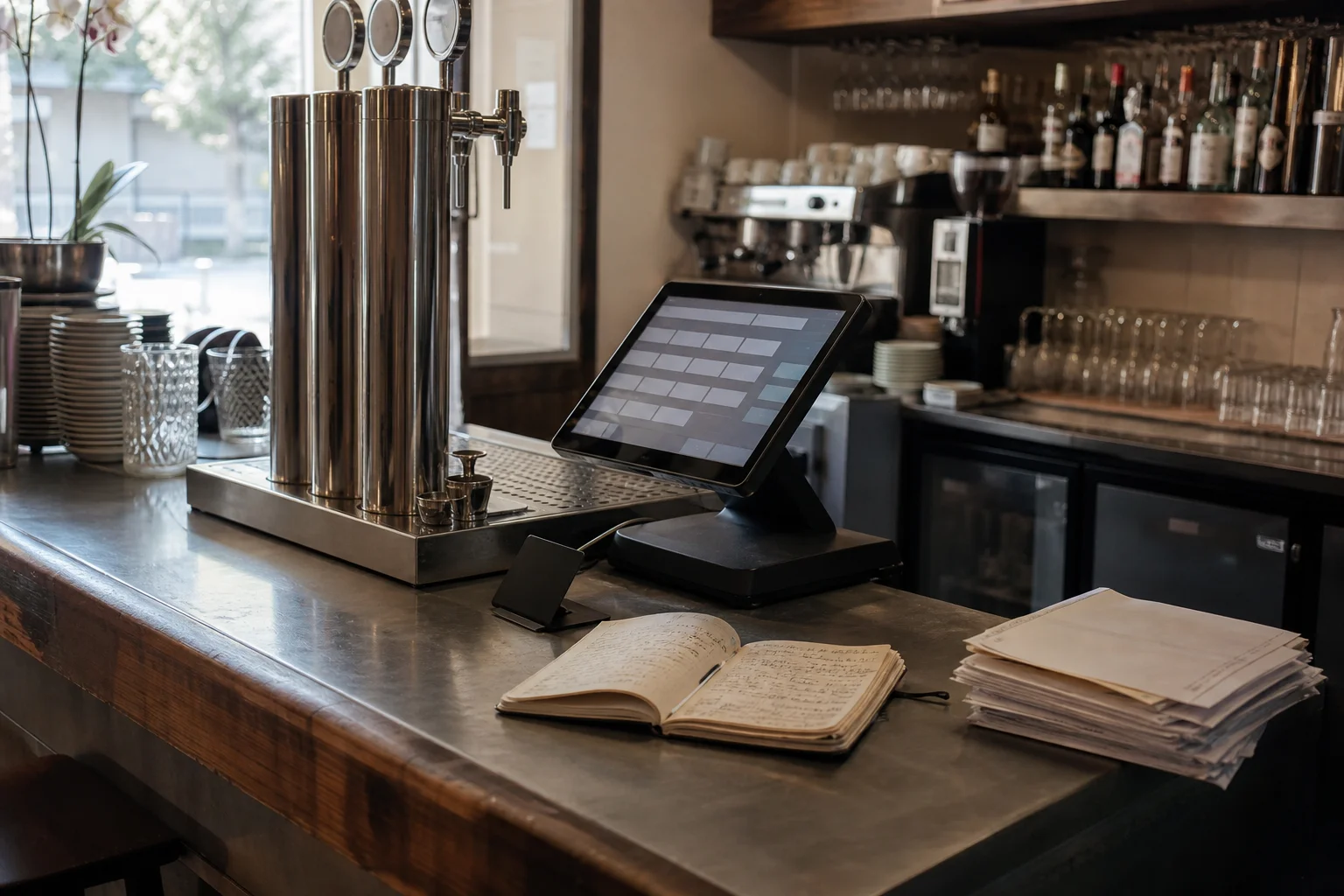
Who does not know a restaurateur who swore they would never replace the cash register with a POS? «A till and a notebook are enough.» Today that same operator will not charge for a beer without putting it through the tablet.
It took them a while, but they got on board. The POS gave them something they could feel from day one: the bill comes out faster, the waiter does not eat the change, and every sale is logged without anyone having to write it down.
Ask them now for the recipe costing of the menu, for what that best-selling dish really costs, and they will most likely pull out a notebook, or the memory of one they had three years ago.
Cloud POS is surging and Verifactu already has a date
According to Makro data, digitization of bars and restaurants keeps growing:
| Tool | Growth (2024/2025 financial year) |
|---|---|
| Total sign-ups for Dish solutions | +63% (3,581 → 5,820) |
| Cloud POS (Dish POS) | +184% |
| Reservation management (Dish Reservation) | +74% |
| Makro digital-channel sales | +42% |
| Customers who bought via Marketplace | 75% |
And Verifactu, the Spanish Tax Agency’s verifiable invoicing system, already has a fixed calendar after the late-2025 postponement:
| Who | Deadline |
|---|---|
| Corporate income tax (SMEs) | 1 January 2027 |
| Freelancers and other companies | 1 July 2027 |
Self-employed: Verifactu is 1 July 2027, not January
The two stories circulating these days say, without nuance, that Verifactu «comes into force on 1 January 2027». That date is real, but only for corporate-income-tax payers. If you are a freelancer, the case for the vast majority of independent hospitality, you have until 1 July 2027, six months more.
And that calendar is not the original one either. The Tax Agency postponed it a full year in December 2025, through Royal Decree-Law 15/2025, after employers’ associations warned there was not enough time to adapt invoicing systems or the POS terminals themselves.
Even with a date in the official gazette we are in no hurry: according to Wolters Kluwer’s 2024 Advisory Barometer, more than half of companies (54,2%) had still not decided how they would comply with Verifactu.
Makro's record is not the sector's cost control
The «record» these stories report is the growth of one supplier, Makro, not a snapshot of the whole sector. And above all: it says nothing about whether the business is managed better, only whether a tool was bought.
Here is the fundamental difference between the POS and the rest of business management. Buying a POS with Verifactu built in will be mandatory from 2027. Running serious cost control is not, nobody fines you for not knowing the real margin on your daily set menu. The POS also stopped asking for extra effort once it moved to the cloud: the data generates itself, as you sell. Traditional management control asks for the opposite: that the owner leave the bar to sit down and punch numbers into a spreadsheet designed for big-company paperwork, not a neighbourhood bar.
Sector surveys confirm it: lack of budget (35-38% of operators cite it as the main barrier) and lack of technical skills in the team (59%) still slow down management digitization. And many businesses that do adopt tools do so without real integration that simplifies day-to-day work, according to the same sector studies.
5,820 sign-ups are under 2% of the sector
5,820 Dish solution sign-ups, however good a figure for Makro, are less than 2% of the more than 300,000 hospitality establishments in Spain (Spanish Hospitality Yearbook). The POS is already practically universal in the sector; what this growth measures is the migration to the cloud and last-minute Verifactu rush, not a sector starting from zero.
On cost control, by contrast, there is no equivalent sector figure. No survey dares to say what percentage of independent bars today knows the real margin of each dish on the menu.
An example with numbers
Own estimate based on an average ticket and a typical neighbourhood-bar cost structure; it is not linked to any source because the calculation is ours.
A bar with 40 menu items turning over €18,000 a month typically runs with a reference gross margin of 65%. If raw-material cost rises 4%, as has happened with oil, coffee or meat over the last two years, and the owner does not review recipe costing or touch the selling price, that margin can fall to 61% without anyone noticing it in the till. That is about 700 € a month evaporating from a menu that, looking at daily takings, still seems just as profitable.
The POS does not catch that leak: it tells you how much you sold, not how much you earned. And neither does the notebook, because nobody has time to recalculate 40 recipe costings every time the price of oil goes up.
What to digitize after the POS
- Pull your three best-selling dishes and check when you last updated their recipe costing.
- Compare this week’s prices from your three main suppliers with those from six months ago.
- If your POS gives you sales by dish, cross them with the real cost of each recipe, not with what you think it costs.
- Check whether your invoicing software is already Verifactu-ready or whether you will have to change it before July 2027.
- Work out how much time you spend each month knowing whether you really make money, and compare it with the time you spend keeping the bar running.
- If the answer is «almost none», try a tool that does not ask you to stop service to give you that figure.
If Hacienda delays again and how many track margin day to day
The Tax Agency already postponed Verifactu a full year in December 2025. There is no guarantee that July 2027 will be, this time, the definitive date.
There is also no reliable public figure for what percentage of independent hospitality truly runs up-to-date cost control, versus running it from memory. Sector digitization surveys measure POS, reservations and online sales; nobody yet measures internal management with the same rigor. Part of this article’s argument rests precisely on that missing figure.
On why that digitization arrives through the Official Gazette rather than return on investment — and what a tech actor would do differently — see the opinion piece Hospitality digitization is not driven by return on investment. It is driven by the Official Gazette.
If you suspect your menu has dishes you think are profitable and are not, tell us which dishes sell most and we'll look.
The POS already arrived. Margin still hasn't.
Suspect your menu hides dishes that are not as profitable as you think?
Tell us which dishes sell most and we will help you look at the real margin, not the one you think you have.
Sources
- Makro reports a 63% rise in adoption of digital hospitality solutions, InfoHoreca
- Spanish hospitality accelerates digitization ahead of a record summer and Verifactu, Hostelería Digital
- Tax Agency delays Verifactu rollout to 2027 for SMEs and freelancers, Hostelería Madrid
- Verifactu: what it is and how it affects your invoicing, Wolters Kluwer