
Hospitality profitability did not fall: it came into the light
By Samuel Carrillo6 min read
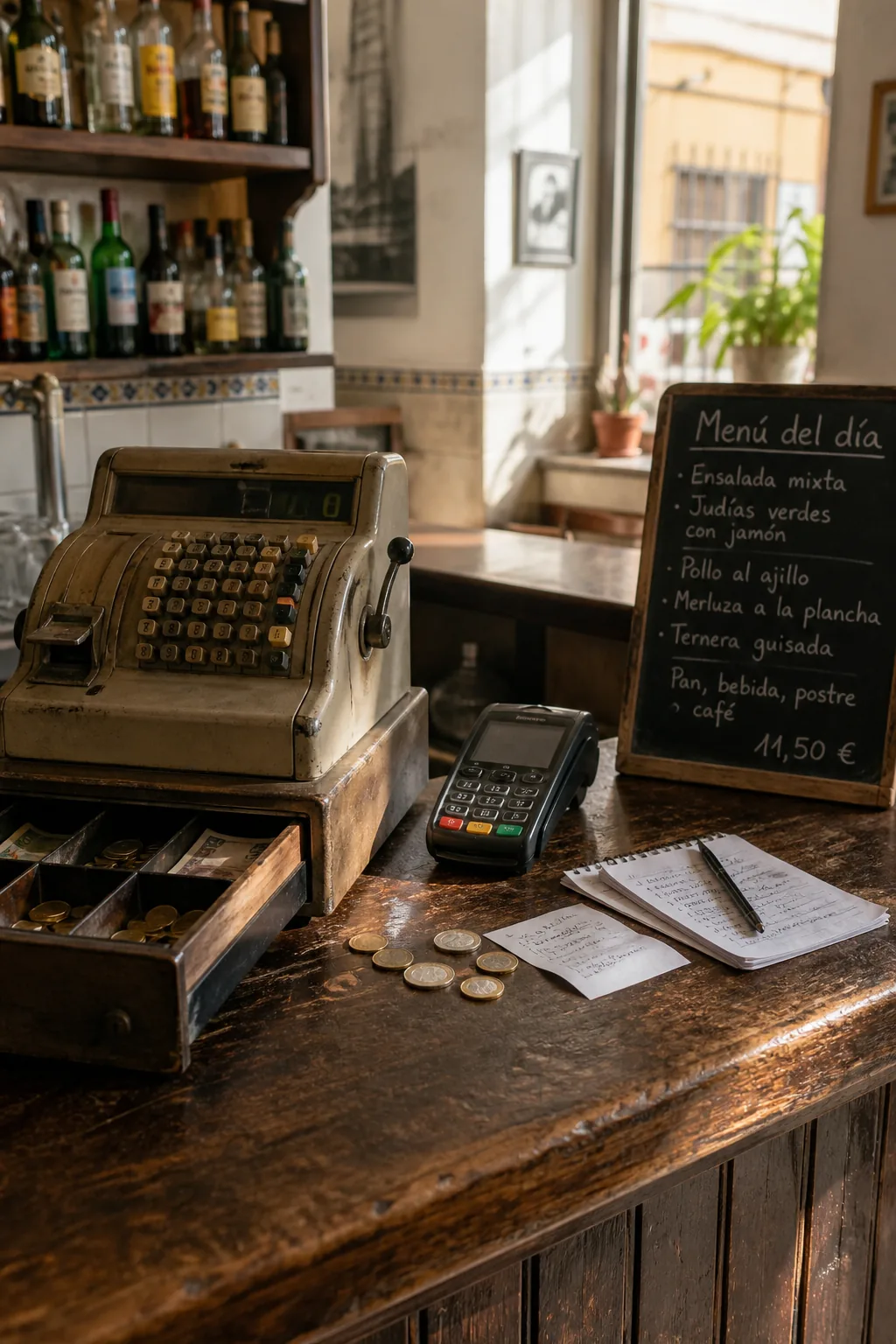
Think of the bar from twenty years ago. Wooden counter, two-page menu, three staff and a cash register that opened with a yank.
The owner had no software, no recipe costing, no data adviser. A notebook and a good memory.
And at year-end there was money left.
Today you have a certified POS, clock-ins, HACCP, insurance, card fees and an adviser you pay every month. And at year-end you do not keep even half.
The strange thing is not that this happens to you. The strange thing is that official statistics say the opposite.
Hacienda's margins versus your till
| Corporate margin 2023 | 12.8% of sales, a record since 2009 |
|---|---|
| Retail and hospitality profitability | rises from 9.9% to 13.4% |
| Set menu price 2016 → 2024 | +19.5% (from €11.7 to €14) |
| Food CPI over the same period | +39.2% |
| Minimum wage 2006 → 2026 | from €540.90 to €1,221: +126% |
| Bars in Spain 2010 → today | from 202,720 to about 164,000 |
The practical takeaway fits in one line: your prices rose half as fast as your purchases, and you covered that gap from your margin.
Why do official figures say hospitality profitability is at highs?
Because they measure what is declared, and that today looks nothing like 2006.
A large share of those 25% or 30% margins never went through the till. Not a moral judgment: accounting. Hospitality, retail and construction concentrate irregularities spotted by the tax agency.
Official margin improves in part because real margin has become visible, not because it has grown. That is our reading: there is no official series that separates surfacing from real growth.
Rent, wages and Verifactu: what eats the margin
Rent. Rent indexed to CPI and competition from uses that pay more.
Wages. The minimum wage from €540.90 (2006) to €1,221 (2026): +126%. Ingredients +39.2% since 2016, more than double your set-menu rise.
Plus costs that did not exist in 2006: time clocks (May 2019), HACCP, card fees, insurance, certified software.
Verifactu: companies on 1 January 2027; other self-employed on 1 July 2027. Fines up to €50,000 per year if the software does not comply. None of those costs bring a customer: they all come out of your margin.
To earn the same, bill 3.6 times more
One euro from 2006 is about €1.45 today (our estimate from the INE CPI series). With 25% EBITDA then and 10% today, you need to turn over about 3.6× more (our estimate): more than double the customers in the same venue. That is why you work more and earn less.
A €300,000 bar, in 2006 and in 2026
2006
You bill €300,000
25% EBITDA: you keep €75,000. In today’s money, about €109,000.
2026
You bill €435,000
The same bar, with updated prices. 10% EBITDA: you keep €43,500.
Same premises. More staff, more rules, more hours. Less than half the real profit.
Example built on our own assumptions. Not a real client case.
So was that 30% real, or was it overstated?
It was real for whoever pocketed it. And oversized as a picture of the sector: some of it was undeclared, and a stack of costs that are mandatory today were missing. What does not come back is the cushion: in 2006 a mediocre bar paid the bills; in 2026 it closes. That is why there are 38,000 fewer bars than in 2010. The sector is formalising and professionalising; with Verifactu, the cash door does not reopen.
Three numbers I'd look at this week
- Calculate your real EBITDA for the last 12 months. Sales minus purchases minus labour minus overhead. Without your own salary inside. It is the number you do not have.
- Cost the five dishes you sell most. Not the ones you like most: the ones that move. That is 70% of your margin.
- List the costs that did not exist in 2006. Add them up. That is your cost of staying compliant, and you have probably never looked at them together.
- Compare the rise in your menu with your supplier’s over the last three years. If your menu lags, you already know where the margin went.
- Put Verifactu on the calendar and ask your POS vendor today whether their software complies. Those who wait until December will pay more.
What Hacienda doesn't break out (and Verifactu may move)
There is no official shadow-economy figure broken out for hospitality alone. There are estimates for the Spanish economy as a whole, but assigning hospitality a concrete percentage would be inventing it. Our surfacing thesis is a reasoned reading, not a data point.
AEAT and Bank of Spain aggregates mix hotels, chains and neighbourhood bars. A coastal hotel and a set-menu bar are not living the same film, and the same figure says opposite things depending on whom you look at.
Verifactu dates have already moved once. They may move again.
If you work more and keep less, the answer is knowing dish by dish where the money goes. Start with your last-12-month EBITDA and the recipe costs of your five top sellers.
Do you know where your margin goes?
We review your EBITDA, the costing of your top dishes and how your menu rose versus your supplier.
Sources
- Corporate margins observatory, Spanish Tax Agency
- Central Balance Sheet Data Office 2024, Bank of Spain
- National Statistics Institute, CPI and hospitality statistics
- Royal Decree 126/2026 (SMI 2026), BOE
- Set menu price study and Hospitality Yearbook of Spain, Hostelería de España
- Royal Decree 1007/2023 (Verifactu) and Law 11/2021 on tax fraud prevention
- Royal Decree-Law 8/2019 (mandatory time tracking)