Artificial intelligence in hospitality: INE says a third of companies already use it. How to tell if the one they are selling you actually helps you
By Samuel Carrillo9 min read
This week a salesperson called you, or two. They all bring an app "with artificial intelligence" that will save you hours, read your sales and answer reviews for you.
You ask what it actually does and they describe something that already existed five years ago. With another logo.
You are not imagining it. Before you sign anything, ask what it lets you do that you could not do before: if the answer is "the same thing, but with AI", it is a shell.
The 33.6% you will see everywhere
The National Statistics Institute published this Thursday its Survey on ICT and e-commerce use in enterprises.
33.6% of companies with 10 or more employees used artificial intelligence in the first quarter of 2026, according to Europa Press. A year earlier it was 21.1%.
In the services sector the figure rises to 38.2%.
Read that way, it looks like AI is already in one in three businesses. In yours, probably not, and not because you are late.
Does INE count bars and restaurants?
First trap in the headline: the 33.6% only measures companies with 10 or more employees.
94% of hospitality businesses have fewer than 10 workers, according to Hostelería de España and CEHAT.
Put another way: out of every 100 businesses in the sector, today's headline talks about 6.
For microenterprises, the latest figure published by INE is 13.4% in the first quarter of 2025, with all sectors mixed together.
The second trap is bigger. INE tables by economic activity exclude CNAE 56, food and beverage service activities. There is no official published figure for how many bars and restaurants use AI.
Everything you read about "hospitality already using AI" comes from private surveys. The most cited this year, the HIP Barometer, says that 44.8% of those planning to invest in technology bet on AI to analyse data.
It is based on 268 responses from HIP attendees, the hospitality solutions fair. That is not the sector: it is the part of the sector that already went to look.
What holds people back is not a lack of tools
If AI is not reaching small venues, the seller's answer is easy: more tools are needed, and cheaper ones. The data say something else.
Among companies with 10 or more employees that considered using AI and did not, 82.4% were held back by lack of knowledge and 47.4% by cost, according to the ONTSI AI use indicators (Red.es), with 2025 data.
That is in companies with staff. In a four-person venue where the owner is also on the plancha, lack of time to learn weighs even more.
Supply, meanwhile, does not stop. The 2024 Alimarket report on restaurant software already described a market saturated with tools, many without integration and hard to use, and the 2026 edition still talks about saturation.
That is the mismatch. Building an app has never been faster. Building something that fits a hospitality week with no free afternoons still costs what it always did: knowing the trade.
What we see from Tipi is a lot of new tools that do the same old thing, with AI on the brochure. And few that use AI for what actually changes something: that a small venue can do what only a group with a control department used to do.
How do I know if an AI tool for hospitality is useful for me?
Three questions. Ask them before you sign anything.
- What does it let me do that I could not do before? Not "what does it do". If the answer is "the same as such-and-such program, but with AI", it is a shell. If it is "something that used to need a person or an afternoon with a spreadsheet, and now you do it in a coffee break", there is something there.
- How much does it ask of me before giving something useful back? If you need to integrate the POS, load the whole catalogue and an afternoon of training before the first result, it is not built for your venue.
- What happens when it gets it wrong? Because it will get it wrong. Ask how you find out, who corrects it and how long it takes. A tool that cannot answer that is not finished, whether it was built in a month or in five years.
And a fourth, as old as time: is there a lock-in? If they trust it helps you, they do not need to tie you down.
What it costs to try something that does not help
Say a tool at €49 a month with a one-year lock-in. That is €588 even if you leave in March.
Add setup: 8 hours between configuring it and learning it, at €20 an hour, another €160. About €750 in the first year for something that, if it fails the first question, does not solve anything new.
Now the other side: a venue with 60 delivery notes a month that takes 4 minutes to key each one spends 4 hours a month, 48 a year, typing. Taking that away does change your week.
Our own tally to show the mechanism: price, hours and hourly value are assumptions, not figures from any real tool.
The difference between the two is not AI. It is whether it solves work you do today.
Tipi is AI too. Put us through the test
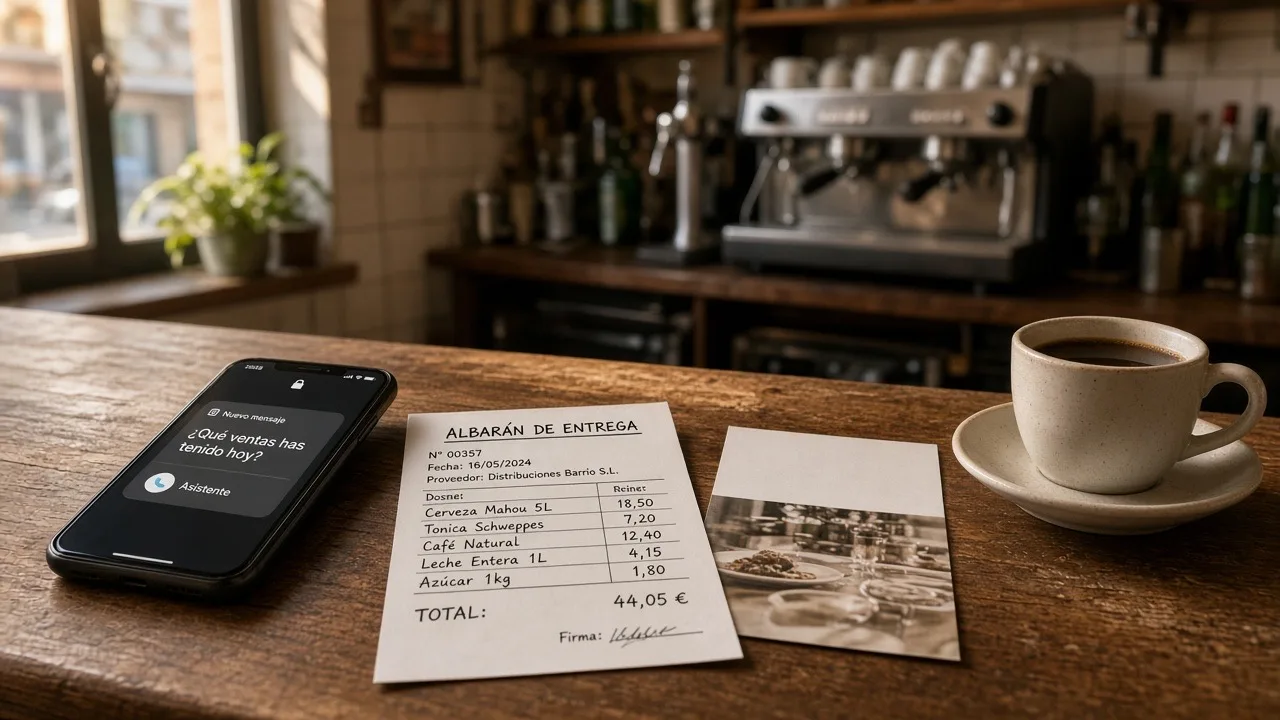
We should say it: Tipi uses artificial intelligence. It builds recipe costs by voice and we read your delivery notes with OCR.
And we did not invent recipe costing: there are tools that have done it well for years.
If you run a group with a central kitchen and need everything connected to your POS and accounting, there are more complete options than ours.
What we try to do is something else: make recipe costing possible for someone who does not have a free afternoon to sit with a spreadsheet, which is exactly why so much of hospitality still does not control costs. If that is not true in your case, we are not for you, and it is better you know before you pay.
What these figures still do not cover
- The 2026 microenterprise figure. What was published today covers firms with 10 or more employees. When we have the figure for those with fewer than 10, we will add it here.
- Whether bars and restaurants even enter the total. We know activity tables exclude CNAE 56. We have not been able to confirm whether it is also out of the overall 33.6%. INE is rolling out the CNAE-2025 classification this year and that could change.
- Whether AI has helped anyone. INE measures who uses it, not whether it saved a euro or an hour. That survey does not exist today.
If someone is selling you an AI tool and you are not sure it passes the three questions, tell us about it and we will look at it with you. Even if the conclusion is that ours is not what you need either.
And if you put us through the test and we fail, we want to know that too.
Does the one they are selling you pass the three questions?
Tell us about it and we will look at it with you. Or put Tipi through the test: voice recipe costing and delivery notes with OCR, no lock-in.
Sources
- INE. Survey on ICT and e-commerce use in enterprises, 2025 and first quarter of 2026. Published 22 October 2026.
- INE. Press release for the same survey, 2024 and first quarter of 2025. Published 22 October 2025.
- Europa Press, via Press Digital. "33.6% of companies in Spain with ten or more employees used AI in the first quarter of the year, according to INE". 22 October 2026.
- Hostelería de España and CEHAT. Statement on the working-time reduction, 4 February 2025.
- HIP Horeca Professional Expo. Barometer on the Competitiveness of Spanish Hospitality 2026. 12 March 2026.
- ONTSI (Red.es). Indicators of artificial intelligence use in Spain, 2026 edition, 2025 data. July 2026.
- Alimarket. Hardware and software reports for restaurants, 2024 and 2026.
- €49/month tally, setup hours and delivery-note example: Tipi's own work to show the mechanism; not figures from any real tool.