
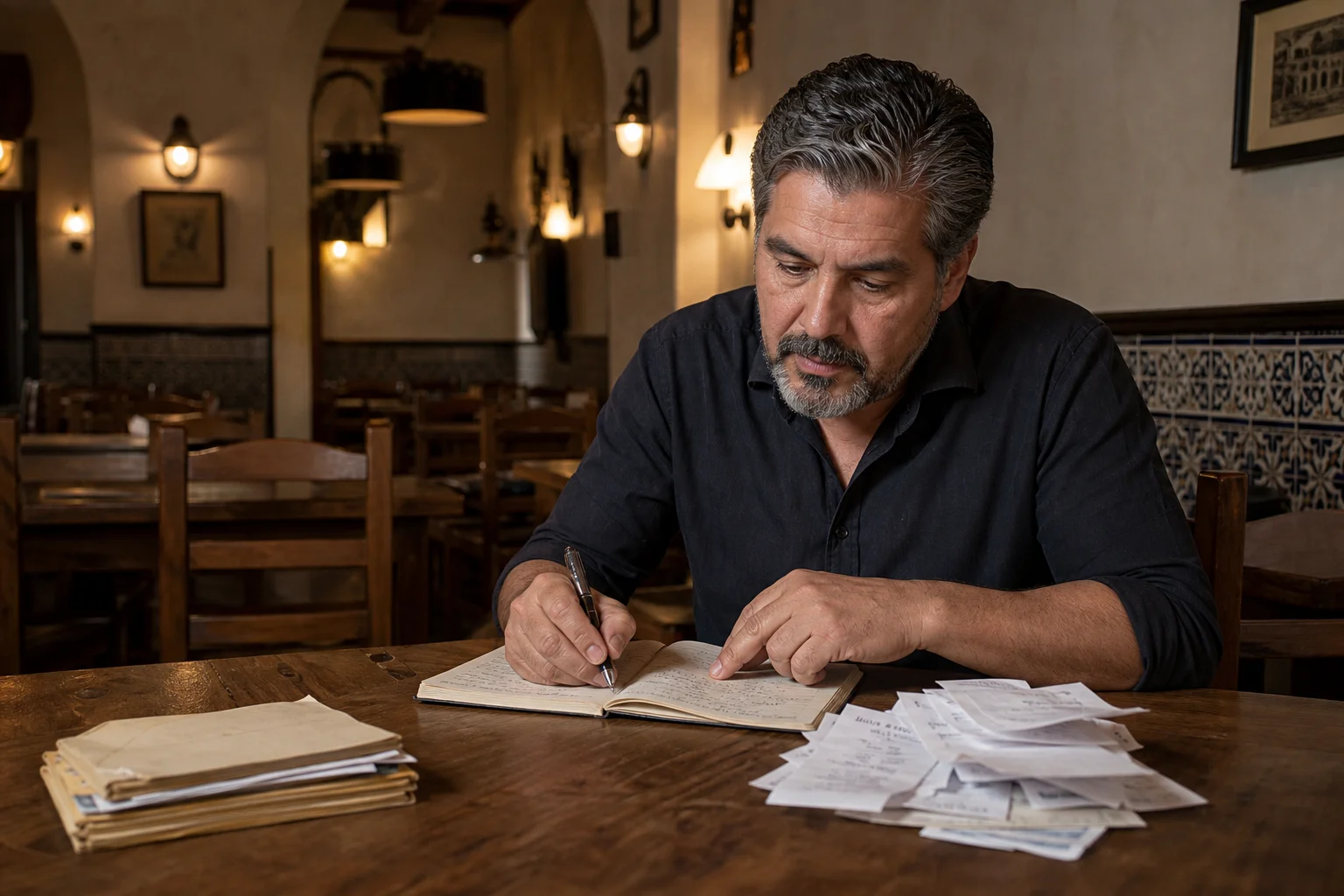
Restaurant numbers: why you can't fully delegate the control
By Samuel Carrillo8 min read
Only 39% of Spanish restaurants review profitability every week, 90% don't make an annual budget and 6 in 10 don't last five years, and the thread connecting those three figures is the same: controlling restaurant numbers cannot be fully delegated, even to the best accountant.
I bet you could explain, without looking at the P&L, why last month's margin moved. You know because you lived it: the fridge broke and you threw stock away, you switched fish supplier, you ran a Wednesday promo that didn't land as you'd hoped.
Your accountant wasn't there. They see the figure, not the scene.
And that gap, between the number and what actually happened in your venue that week, is the one that costs dearly when nobody is in charge of closing it.
Who should control a restaurant's numbers?
There aren't two camps here. There are two different jobs that often get confused as one.
| What your accountant does | What only you know |
|---|---|
| Closing VAT, payroll and tax filings | Why average ticket dropped on Thursday |
| Preparing the monthly P&L | That the new supplier is pushing food cost up |
| Flagging a variance | Whether that variance is a problem or a one-off |
| Meeting tax deadlines | Whether it will repeat or it was a one-month blip |
An accountant, yours, anyone's, does their job well when they balance the books and tell you something has moved. What they cannot do, however hard they try, is tell you why it moved. That part is only yours, because only you were on the shift.
If you also want to know how often to look at them, we already covered the exact cadence in this article.
70% feel stable, but only 39% review every week
The study Challenges of Foodservice in Spain, by TheFork with consultancy Toluna among 615 industry professionals, leaves an uncomfortable figure: 70% of operators consider their economic situation stable, but only 39% review profitability every week. More than half look at their numbers only once a month.
In other words: most people feel secure without checking the figure at the frequency that would let them actually know. The feeling of solvency and real solvency do not always go together. And the only way they go together is if you look yourself, often, and match what the number says with what you know happened on the floor.
The uncomfortable part: nobody will do it for you
Taking on this control takes time, and most people do not do it. 90% of restaurants don't prepare an annual budget, as chef Ferran Adrià has repeated, attributing a large share of sector closures not to the cooking, but to the lack of financial management.
That 90% is not the same as the field estimate — around 90% without a P&L — in the SEGITTUR study. Same figure, different meaning; we unpack the belief of keeping numbers in your head in how to know if your restaurant is profitable.
"The management piece is very, very important."
And he isn't speaking from theory: 6 in 10 restaurants that open don't last five years.
Delegating the execution to an accountant is not the problem. The problem is delegating the understanding too: not knowing what your P&L says, having no budget, and finding out something was wrong when it's already too late to fix it.
What do you gain if you start controlling the numbers yourself?
It isn't only avoiding the hit. There's an upside too.
You actually understand your business. What's working, what's surplus, what leaves margin and what only takes up space on the menu. Nobody from outside tells you that with the precision of looking yourself every week.
You learn to trust your own numbers, not only someone else's. I myself found accounting errors while working with José Andrés, with a first-class team behind him. If that happens with a team of that level, imagine what can happen when nobody looks twice.
You know when money comes in and why, and when it goes out and why. That tracking is what stops what is so hard to earn from evaporating, simply because you assumed that control was out of your reach.
And you don't need to spend an hour a day on something you don't enjoy. Sometimes 15 minutes a week is enough to find hundreds of euros of improvement in your business.
183,000 businesses without a weekly thermometer
Spain has more than 300,000 hospitality venues, according to the Spanish Hospitality Yearbook. If 61% don't review profitability weekly, the reverse of the 39% who do, that's our own estimate of about 183,000 businesses operating without the thermometer on for most of the month.
The correlation with Adrià's figure doesn't have to be causal for the point to land: the fewer of your own eyes are on the business, the less room to react when something goes wrong.
A worked example with figures
A restaurant turns over €30,000/month with a 9% net margin (€2,700). One month it switches meat supplier without comparing prices and food cost rises 2 points: €600 less margin that month.
If nobody looks until the quarterly meeting with the accountant, the problem has been running for three months: €1,800 lost before anyone flags it.
If the owner reviews food cost every week (10–15 minutes), they catch the variance in the first week, compare prices and decide whether to go back to the previous supplier or renegotiate. Real cost: one week of worse margin, about €150, instead of €1,800 in a quarter.
The difference between the two scenarios isn't the figure. It's who looks, and when.
Five actions to take back control this week
- Block 15 minutes every Monday for you, not your accountant, to look at last week’s food cost and average ticket.
- Ask your accountant for the P&L in a format you understand, not only the one the tax office requires.
- Note the facts of each week, a breakdown, a supplier change, a promo or a local event, so you have something to match the number against when you look.
- Before your next meeting with the accountant, write down first what you think happened with the numbers. Then compare it with what they tell you.
- If two weeks in a row you couldn't explain a swing of more than 2 points in your margin, that's the symptom that the gap is too wide.
What to take with a pinch of salt in these figures
The 39% who review weekly comes from a perception survey of 615 professionals, not a match against real sales data. There may be overestimation bias, which is common when operators are asked directly about their own habits.
Ferran Adrià’s “6 in 10 don’t last five years” is a figure he has repeated in different appearances for months, but we have not located the original study or statistical source behind it. We treat it as a figure repeated by a voice with standing in the sector, not as an official verified statistic.
Your accountant keeping the numbers is not the problem. The problem is that they are the only one who understands them. If the next time the P&L arrives you couldn't explain why something changed, tell us and we'll say where to start.
If something new comes up on this, you'll hear it here before anywhere else.
Does the P&L arrive and you couldn't explain why it changed?
That gap between the number and what happens in your venue is the one we close with Tipi. Tell us and we'll say where to start.
Sources
- Diario AyE (Autónomos y Emprendedor), Only four in ten restaurants review their accounts weekly to check if they are profitable, 18 March 2026
- El Español, Ferran Adrià, Michelin chef: 'A restaurant is the hardest business there is', 23 March 2026
- El Español (Cocinillas), Ferran Adrià: 'Six in ten restaurants don't last more than five years', 20 November 2025
- OKDiario, Ferran Adrià explains why so many restaurants close in Spain, 29 June 2025