
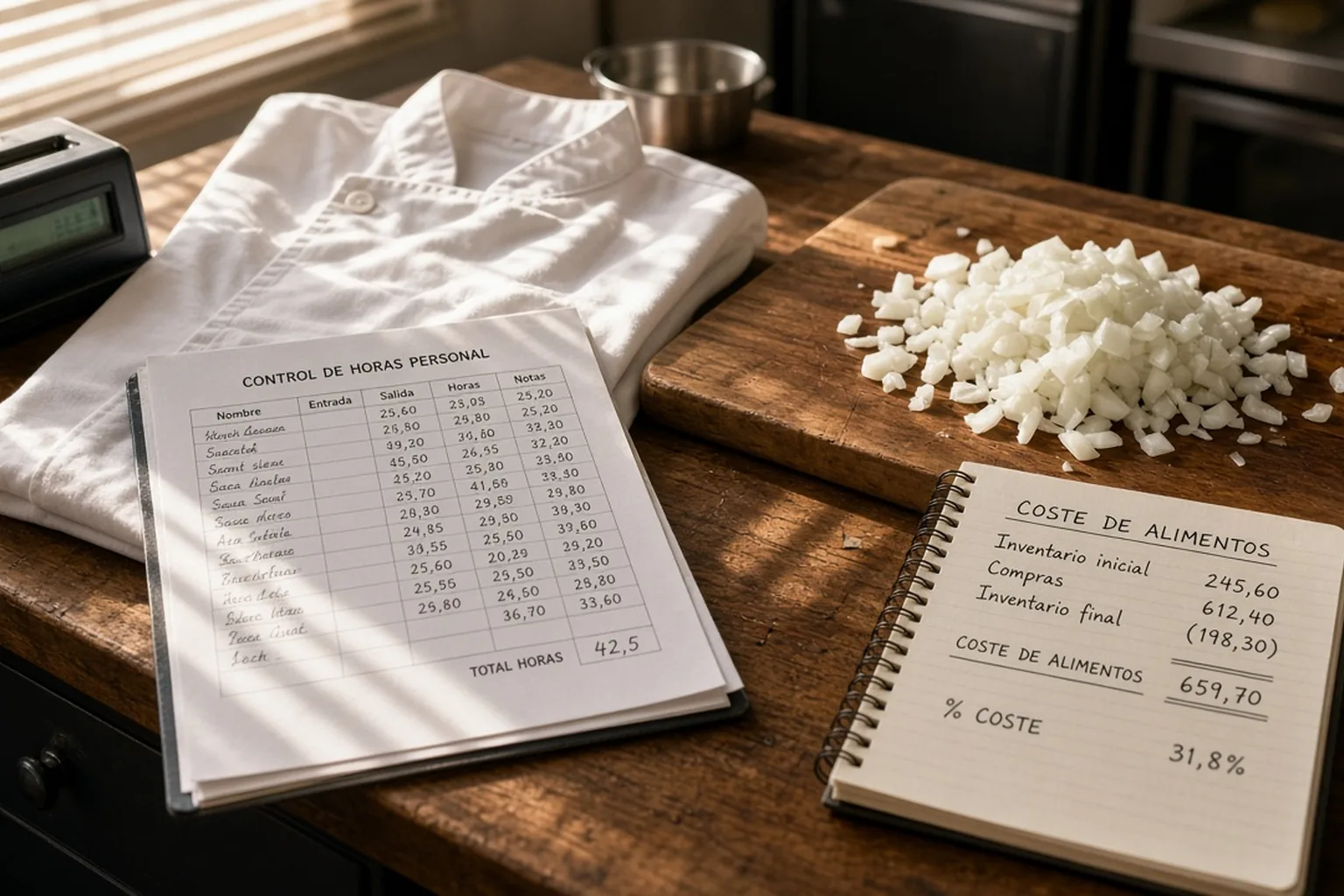
Restaurant prime cost: the famous 70% is not the barrier — it's the edge of the cliff
By Samuel Carrillo11 min read
Published 22 October 2026.
Your accountant calls. «Food cost is 29% — you're fine.»
You hang up relieved. And at month-end, again, the books don't cover what you put in.
They didn't lie. They gave you half the number.
What is restaurant prime cost
Prime cost is the sum of consumed product cost and total labour cost, expressed as a percentage of sales excluding VAT.
They are read together because they trade off. If you buy ready-made, food cost rises and kitchen labour falls.
That is why food cost alone misleads. A 29% food cost with labour at 42% is a 71% prime cost. One at 34% with labour at 28% is 62%.
Site A
«Low» food cost, 71% prime cost
Product 29% · Labour 42% · Almost nobody makes money
Site B
«High» food cost, 62% prime cost
Product 34% · Labour 28% · The one that makes money
The second site — the one with the «high» food cost — is the one that makes money. We unpack the first half of the sum in why food cost is not a single number.
Are you safe below 70% prime cost?
The 70% figure has been around for years and there is some truth in it. Above 70%, except at very high sales volumes, almost no restaurant makes money.
What does not hold is reading it backwards. The most-cited US industry reference says a full-service restaurant should not go past 65%.
That is where the trouble starts. At 70% the problems are already almost certain.
70% is the edge, not the target. The alarm line is 65%.
Three reasons your 70% is not the manuals'
First: the number comes from a country where tips pay wages. In the United States, federal law allows paying a server $2.13 an hour if tips bring them up to the minimum wage.
Part of front-of-house is paid by the guest outside the ticket. Not here — so for a similar site, labour should weigh more in Spain.
Second: gross pay is not what a worker costs you. Order PJC/297/2026 sets for the employer 23.60% common contingencies, 5.50% indefinite unemployment, 0.60% training, 0.20% FOGASA and 0.75% MEI.
That is 30.65% on top of gross, before workplace accident cover. If you only add gross wages, you are missing almost a third of labour cost.
Third: VAT in the denominator. If you invoice €30,000 ex-VAT, you take €33,000 with 10%.
A 60% prime cost becomes 54.5% if you divide by cash collected. Five and a half points of false calm.
Your ceiling depends on what you pay in rent
What prime cost does not take pays rent, utilities, accounting, insurance, card fees, maintenance and tax. What is left is profit.
According to the INE Structural Business Statistics, Spanish foodservice turned over €61,074 million in 2022 with a gross operating surplus of €5,373 million, reported in the Fundae sector study.
That is 8.8% of sales, before depreciation and tax. And that 8.8% includes what owner-operators take who are not on payroll.
Meanwhile labour already weighs in: according to Hostelería de España, wages average 31% of annual sales.
Your prime cost ceiling is calculated like this:
A site at €30,000 a month with €3,000 rent, €1,800 utilities and €1,500 other costs has 21% left for the rest. To earn 8%, its ceiling is 71%.
With €5,000 rent, the rest rises to 27.7% and the ceiling falls to 64.3%.
Same menu, same team, seven fewer margin points because of the lease. Example figures, not sector averages.
Rent €3,000
Ceiling 71%
Rent €5,000
Ceiling 64.3%
If you work every day without a wage, your number is false
In food and drink there are about 148,000 employers with staff and 119,000 without employees, per the 2023 LFS as reported by Fundae. Their work does not appear in any labour line.
The clue: in foodservice, firms with 0–1 employees generate €3.37 of value added per euro of labour. Those with 2–9, €1.29.
It is not that the small site is two and a half times more efficient. Our reading: the owner's work is not on the books.
The case, with numbers
A restaurant turns over €30,000 a month ex-VAT. Product, €9,000. Labour at employer cost, €9,000. Other costs, €6,300.
Prime cost: 60%. €5,700 left. The accountant is right.
But you are in the kitchen 60 hours a week. Paying someone to do your job, at €2,500 gross over 14 pays, would cost about €3,800 a month. Our calc: head-chef wage plus 2026 employer social charges.
With that cost inside, real prime cost is 72.7%. The other side of the edge.
The business makes €1,900 a month beyond your work — 6.3% — before depreciating the kitchen.
The other €3,800 was not lost: it is your wage. You just need to know that it is.
Prime cost on paper
60%
With your wage inside
72.7%
Three numbers to pull before Sunday
- Product consumed, not purchased. Purchases plus opening stock minus closing. With invoices alone, the month you fill the cooler looks like a disaster.
- Labour at employer cost. Ask your accountant for total social-security cost for the month, not just net/gross payslips. Cash-in-hand is labour too.
- Your wage and your ceiling. Put in the cost of replacing you under your province's collective agreement, and calculate your max with the rent formula.
If with your wage inside you clear 65%, the problem is no longer food cost. It is how many people you need per service and at what price you sell.
What nobody has measured yet
- There is no official Spanish prime-cost benchmark. 65% and 70% come from the US industry.
- Spanish references disagree: some put healthy labour at 25–30% and others at 35–40%. With a typical food cost, «normal» prime cost would run from 55% to 72%.
- How many points US tipping buys you has not been calculated by anyone we found.
- INE data is from 2022 and mixes bars, independents and chains.
- What wage to give yourself has no rule. Replacement cost under the agreement is the most defensible — but it is a convention.
If you want that number from your invoices, not an example, do it with Tipi: tell us and we will put numbers on it.
70% belongs to someone else. You set your own line — with your wage inside.
Want to see your real prime cost?
Tell us and we will put numbers on it with your invoices, not an example.
From Tipi we help you put your wage inside the number and set your ceiling.
Sources
- Hostelería de España and CEHAT. Statement on working-time reduction, 29 May 2025.
- Fundae (PwC). Hospitality sector trends study, April 2025, from INE Structural Business Statistics and LFS.
- INE. Structural Business Statistics: Services sector.
- BOE. Order PJC/297/2026 of 30 March, Social Security contribution rates for 2026.
- U.S. Department of Labor, Wage and Hour Division. Minimum wages for tipped employees.
- US industry prime-cost benchmarks (RestaurantOwner, Mirus, 7shifts, Baker Tilly), consulted October 2026.
- Skello and ComboHR, Spanish foodservice labour-cost ranges, consulted October 2026.