
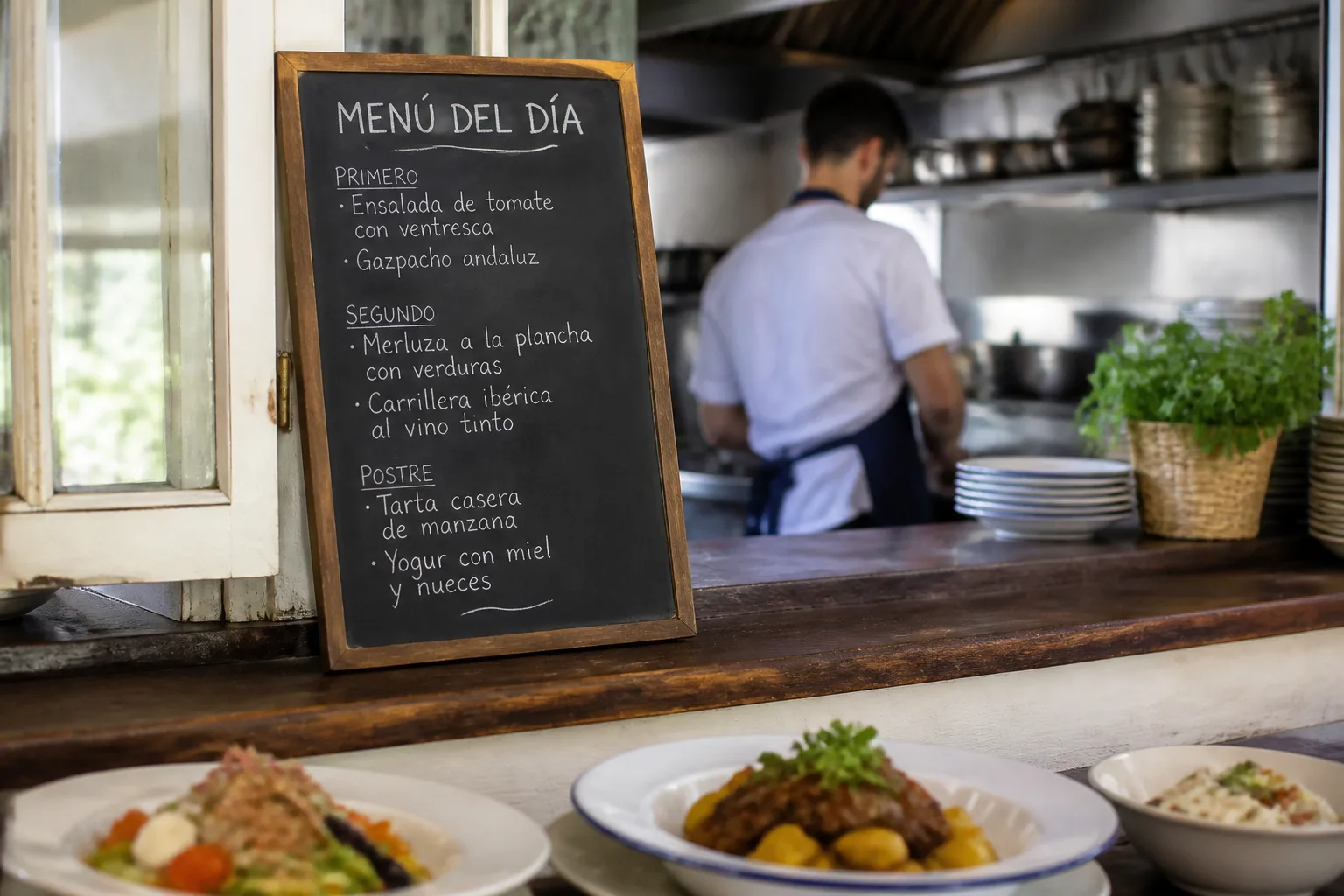
How to cost a menu of the day
By Samuel Carrillo8 min read
A €16 menu of the day only leaves you €4.30 for starter, main and dessert. The average price in Spain is €14.20, according to the Hostelería de España and Edenred study published on 24 November 2025. And costing a set menu is not the same as costing an à la carte dish: there are add-ons that earn no margin, 10% VAT that almost nobody strips out before calculating, and a split across courses that decides what actually goes on the board.
If you are coming from how to make a recipe costing step by step, the next step is different: apply that logic to the whole menu, not a single dish.
The day you put seafood cannelloni on the board
You had product and it looked good on the board.
You put them as a starter, next to the mixed salad, thinking the two would balance each other.
That lunchtime eighty people came in and forty ordered cannelloni. Nobody did anything wrong. The guest simply chose, which is what they always do.
At month end you look at the numbers and they do not add up. And they do not add up because of that.
Menu-of-the-day costing in five steps
There is no single model. This is the one we use, in five steps.
| Step | What you do |
|---|---|
| 1 | Add the cost of the add-ons: whatever the menu always includes |
| 2 | Subtract that cost from the selling price |
| 3 | Apply your target food cost to what is left |
| 4 | Split that cost across starter, main and dessert by how much each weighs |
| 5 | With that you know which dishes belong on the menu and which do not |
The difference from à la carte costing is in steps 1 and 4. The rest is the usual work.
Do you strip out VAT before costing the menu?
Yes. And this is the step people skip most often.
A €16 menu is not €16 of yours: it is €14.55. The other €1.45 is 10% VAT, and that money belongs to the tax office from minute one.
If you cost on the VAT-inclusive price, you think you can spend €4.79 on the three courses. The real figure is €4.30.
That is 48 cents per menu. At 1,000 menus a month, about €480 you thought you had and did not.
Add-ons do not earn money; they cover their cost
Bread, drink and coffee. In some places the aperitif too.
They sit inside the price. The guest does not choose whether to take them and you do not choose whether to serve them.
Our rule: add-ons do not earn margin; you only recover their cost. That is why add-on cost is subtracted from the taxable base before you calculate anything else.
With €1.50 of add-on cost on that €14.55, you have €13.05 left before applying target food cost.
How much can I spend on each course of the menu?
A mixed salad starter is not the same as seafood cannelloni. Splitting cost equally across three courses is the fastest way for the main to eat the whole menu.
We start from this split. It is our starting point, not an industry standard: every kitchen has to tune it to its menu.
| Course | Maximum cost on a €16 menu |
|---|---|
| Starter (35%) | €1.51 |
| Main (50%) | €2.15 |
| Dessert (15%) | €0.65 |
That is the filter. A dish that goes over does not go on, or it goes on knowing what it costs to include it.
That 33% is not your menu food cost
If you apply a 33% target food cost to the €13.05 left after add-ons, the three courses cost €4.30.
But for the full menu you have to add the add-ons back in.
Total menu cost: €5.80 on a €14.55 base. 39.9%.
That is not a maths error. It is the consequence of the earlier decision: add-ons go in at cost and contribute no margin. If you thought your menu ran at 33%, it runs at 40%.
48 combinations and you only control the average
Four starters, four mains and three desserts are 48 possible combinations.
The guest picks one. You do not.
Here is a case with real costing numbers: starter €1.48, main €3.38, dessert €1.07. Total, €5.93 across the three courses.
On a €23 menu that combination fits easily: the budget is €6.40 and you have 47 cents to spare.
On a €16 menu the budget is €4.30 and you are €1.62 over. That guest’s real food cost jumps to 51%.
At 1,000 menus a month, if that were the dominant combination, €1,620 of margin disappears.
In that combination the real cost split was 25% starter, 57% main, 18% dessert, when the plan was 35 / 50 / 15. The main took seven points that were not its own.
That is why your menu average can look perfect and you can still lose money every day.
What costing will not fix: waste
The menu of the day runs on volume. Volume means tighter margins, and tighter margins mean waste weighs twice as much as on the à la carte menu.
No spreadsheet will save you here. The secret is selling it all through, and that is demand control plus the head chef’s craft.
Costing tells you what you can put on. Waste decides how much you take home.
Five steps to cost your menu this week
- Cost the add-ons first. Bread, drink, coffee. Half an hour, and it is the number that pulls everything else.
- Divide your price by 1.10 and always work with that figure.
- Set your split across starter, main and dessert. If you do not have your own, start with 35 / 50 / 15 and tune it.
- Get the maximum cost per category and run that filter on the dishes already on the board.
- Ask the kitchen to note for one week which combination each table orders. Without that, you are costing blind.
The 33%, the 35/50/15 split and what is still missing
33% food cost is not a law. It is a comfortable starting point, and some menu-of-the-day houses work fine at 38% because volume holds it up.
The 35 / 50 / 15 split is our criterion, not a published standard. If your menu is stew-heavy, the starter may weigh more.
And the hardest bit remains: step 6, which does not exist yet — knowing in advance which concrete combinations break the margin and how to fix them without touching the price. At Tipi we are working on exactly that. If you want to try it early and tell us what you are missing, write to us.
If you want to know whether your menu actually makes money, stop wasting time: write to us and we’ll put numbers on it.
See you next time, a few of these drop every month.
Want to know whether your menu of the day actually makes money?
We cost the add-ons, VAT and per-course filter with you. Write to us and we’ll put numbers on it.