
How to make a recipe costing: step-by-step guide (with a burger example)
By Javier Porras7 min read
Updated 13 September 2026.
If you're coming from the guide on dish cost, you already know why calculating by eye can cost you thousands of euros a year. Here we get concrete: how to build the recipe costing for a dish, step by step, with Carlos's burger as the example.
When you finish, you'll have the cost per portion. Then you can move on to food cost and gross margin to see how much you really earn on each sale.
If you want to do it by voice from the kitchen, without a notebook, go to voice recipe costing without a computer.
01 Full list: including what «costs little»
And when I say every, I mean every. Not only the meat, fish or main ingredient. You should also include:
- Oil, salt and spices.
- Sauces, bread and garnishes.
- Decorations and consumables directly tied to the dish.
- Packaging and bags for delivery or takeaway orders.
One of the most common mistakes is ignoring the small ingredients because «that costs next to nothing». And it's true. Two grams of salt cost very little. The problem is that salt is rarely the only thing forgotten. Part of the oil gets forgotten too. The sauce. The bun. The garnish. The small container. The ketchup sachet. The special napkin. The garnish.
And when you add up all those small costs and multiply them by thousands of covers, they stop being so small. You don't need to obsess over counting every peppercorn. But you do need a reasonable estimate of every consumption that goes into the dish. Because what you leave out of the recipe costing doesn't disappear. You still pay for it. You simply don't know you're paying for it.
Trampa: dejar fuera el aceite de freír o el pan «porque ya está en otra partida». Acción: cierra la lista con el plato delante, no desde memoria. Lo que no está en el escandallo no desaparece: lo sigues pagando sin verlo.
02 Weights the kitchen can repeat
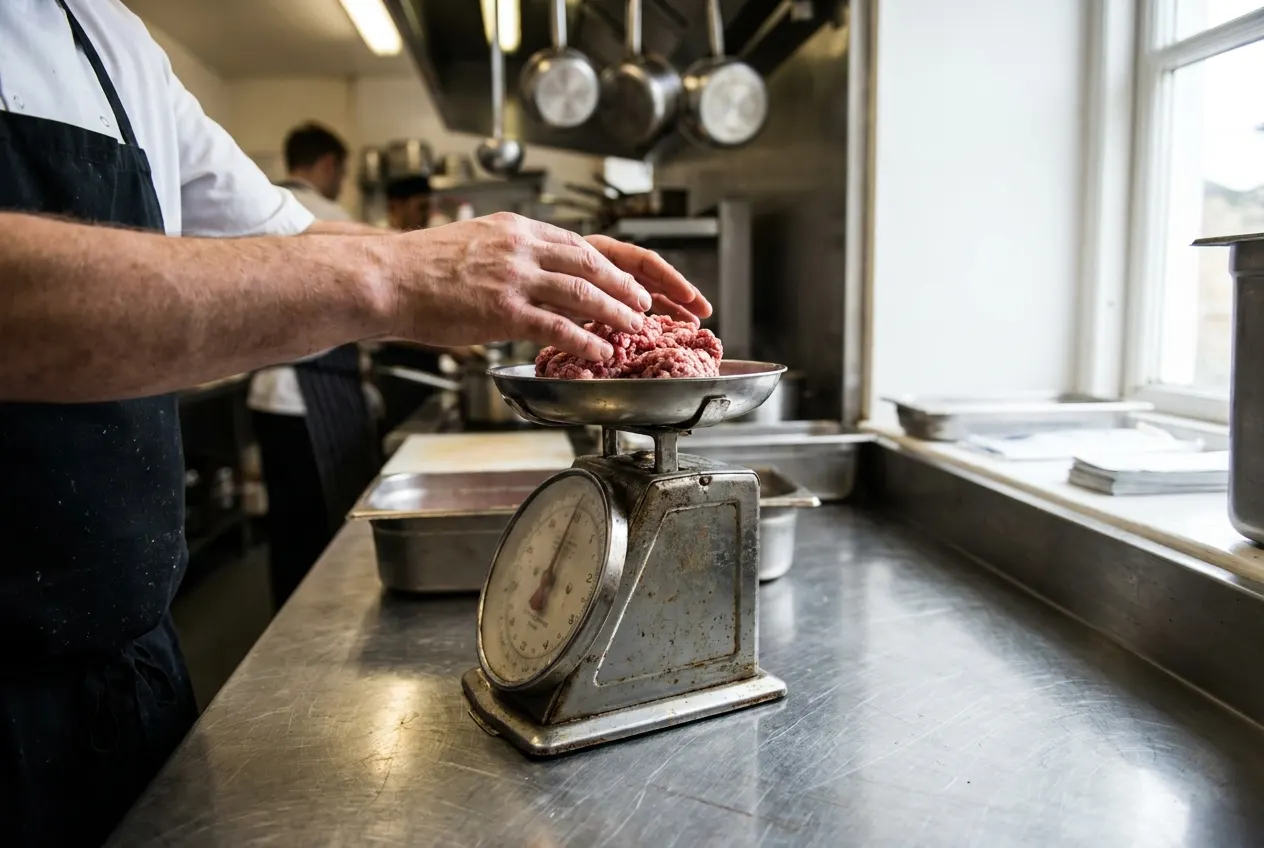
This is where «a bit», «a handful», «more or less», «whatever it takes», «until it looks enough» ends. You need concrete quantities: 180 grams of meat, 250 grams of potato, 30 grams of sauce, 10 millilitres of oil, two 20-gram cheese slices, one bun.
When each cook uses a different amount, it isn't only the presentation that changes. The cost changes too. Suppose the recipe card says a burger should carry 150 grams of meat, but the kitchen is using 180 grams. You're serving 30 extra grams on every plate.
And we're talking about a single ingredient. A recipe card isn't there to decorate a folder. It's there so the dish carries the same amount when you cook, when your head chef cooks, and when someone new joins the team. That protects cost. But it also protects the guest experience. Because nobody wants a spectacular burger on Saturday and a skinny version on Tuesday.
Trampa: apuntar 150 g y servir 180 g «porque queda mejor». Acción: pesa tres pases reales esta semana y corrige la ficha o el hábito. El Excel no cocina.
03 Price per kilo, litre or unit (up to date)
To work out how much the quantity used in a recipe costs, you first need the ingredient price in a usable unit: euros per kilogram, euros per litre, euros per unit.
You buy a box of 24 eggs for €5.28:
You buy a five-litre jerry can of oil for €27.50:
And here's a fundamental detail: always use up-to-date purchase prices. A recipe costing based on last year's prices can give you a completely false sense of profitability. The dish doesn't know you haven't updated the spreadsheet. Neither does your supplier.
Trampa: copiar el precio de la web del proveedor sin mirar el último albarán. Acción: toma el precio del albarán más reciente de ese producto antes de cerrar la ficha.
04 Costs and sales without VAT (or the margin lies)
When you analyse sales, costs and margins you should use amounts excluding VAT. Why? Because the VAT you charge the guest is not real restaurant revenue. You collect it to settle it later with the tax authorities.
Even though the guest paid €14.50, to calculate food cost and margin you must use the €13.18 net. This mistake is very common. And it can make you think a dish leaves more money than it really does. You'll see the full calculation in food cost and gross margin.
Trampa: restar IVA solo a la venta y dejar el coste con IVA «porque viene así en la factura». Acción: trabaja ambos lados sin IVA. Si tu proveedor desglosa, usa la base.
05 Waste and yield: usable kilo, not purchased kilo
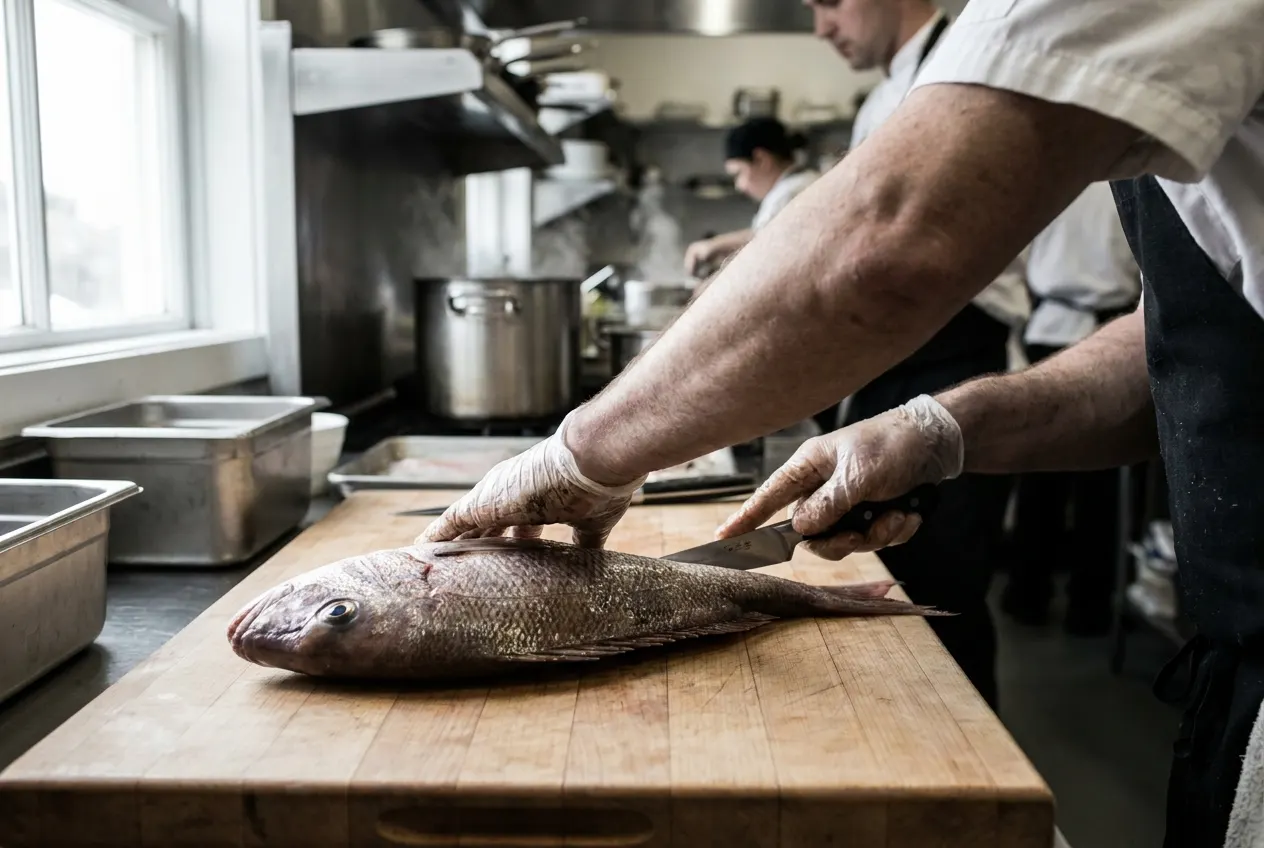
This is one of the places where the most money can hide. Not everything you buy ends up on the plate. Fish has head, bones and guts. Meat can lose fat, bone or water. Vegetables get peeled. Some foods lose weight during cooking.
Suppose you buy fish at €12/kg. After cleaning it, you only use 80%:
The supplier hasn't cheated you. Neither has the waste. The problem is that you were calculating as if you could serve the bones, the skin and the head.
Trampa: usar un % de merma «de manual» sin pesar tu propio rendimiento. Acción: limpia o cocina un lote, pesa útil vs comprado, y fija tu %.
06 Add up and divide by the portions that actually come out
Once you know the cost of each ingredient, you only need to add them up. Let's look at Carlos's burger:
| Ingredient | Quantity | Cost |
|---|---|---|
| Brioche bun | 1 unit | 0,42 € |
| Beef | 180 g | 1,98 € |
| Cheese | 2 slices | 0,28 € |
| Bacon | 40 g | 0,34 € |
| Lettuce | 20 g | 0,05 € |
| Tomato | 40 g | 0,09 € |
| Onion | 20 g | 0,04 € |
| House sauce | 30 g | 0,16 € |
| Chips / potatoes | 250 g | 0,40 € |
| Frying oil | 60 ml | 0,16 € |
| Salt | 2 g | 0,01 € |
| Pepper and spices | 1 g | 0,02 € |
| Total cost per portion | 3,95 € |
The general formula is:
This matters especially for large batches such as sauces, stews, cakes, croquettes, stocks, desserts and prep work. For example: total cost of a croquette recipe: €24. Actual yield: 80 croquettes.
And here's another important rule: don't divide by the portions you think should come out. Divide by the ones that actually come out. Because on paper you always get more croquettes. Then someone hits the kitchen, makes them a bit bigger, and ten units go missing.
Trampa: redondear a la baja «para que el food cost quede bonito». Acción: deja el coste feo y verdadero. El arreglo viene después, en precio o en receta.
With cost per portion in hand, the next step is to know how much you really earn on the dish. And if you want to check that the paper holds up in the kitchen, read theoretical vs actual cost.
Where the costing breaks (even if it's well made)
Se rompe cuando nadie lo usa en el pase. Cuando el precio cambió hace tres albaranes. Cuando la merma real no es la del papel. Cuando el delivery lleva envase que no está en la ficha.
También se rompe si escandallas un plato y asumes que el mes entero cuadra: sin inventario, el teórico es intención. El real es lo que consumiste.
Desde Tipi puedes dictar la receta y mantener precios al día. No sustituye pesar en cocina: acorta el tiempo entre el dato y la decisión.
Si quieres construir el escandallo sin pelearte con la libreta, cuéntanoslo y lo miramos.
Cost one star dish this week. The rest can wait. That number cannot.
Same burger, dictated: Tipi calculates the cost
The six steps above are the method. If you want to skip the notebook, this is the same recipe costing dictated in the app.
Want the costing without fighting the notebook?
Con Tipi dictas la receta, actualizas precios y ves el coste por ración. Cuéntanoslo y lo miramos.
Sources
- Tabla de hamburguesa (3,95 € por ración) y ejemplos de huevos, aceite y merma de pescado: elaboración propia de Tipi en la serie de coste por plato. No son datos de un local concreto.
- Uso del precio sin IVA para margen y food cost: coherente con el tratamiento del IVA repercutido como tránsito, no como ingreso del local (ver Agencia Tributaria, tipos de IVA en hostelería).