
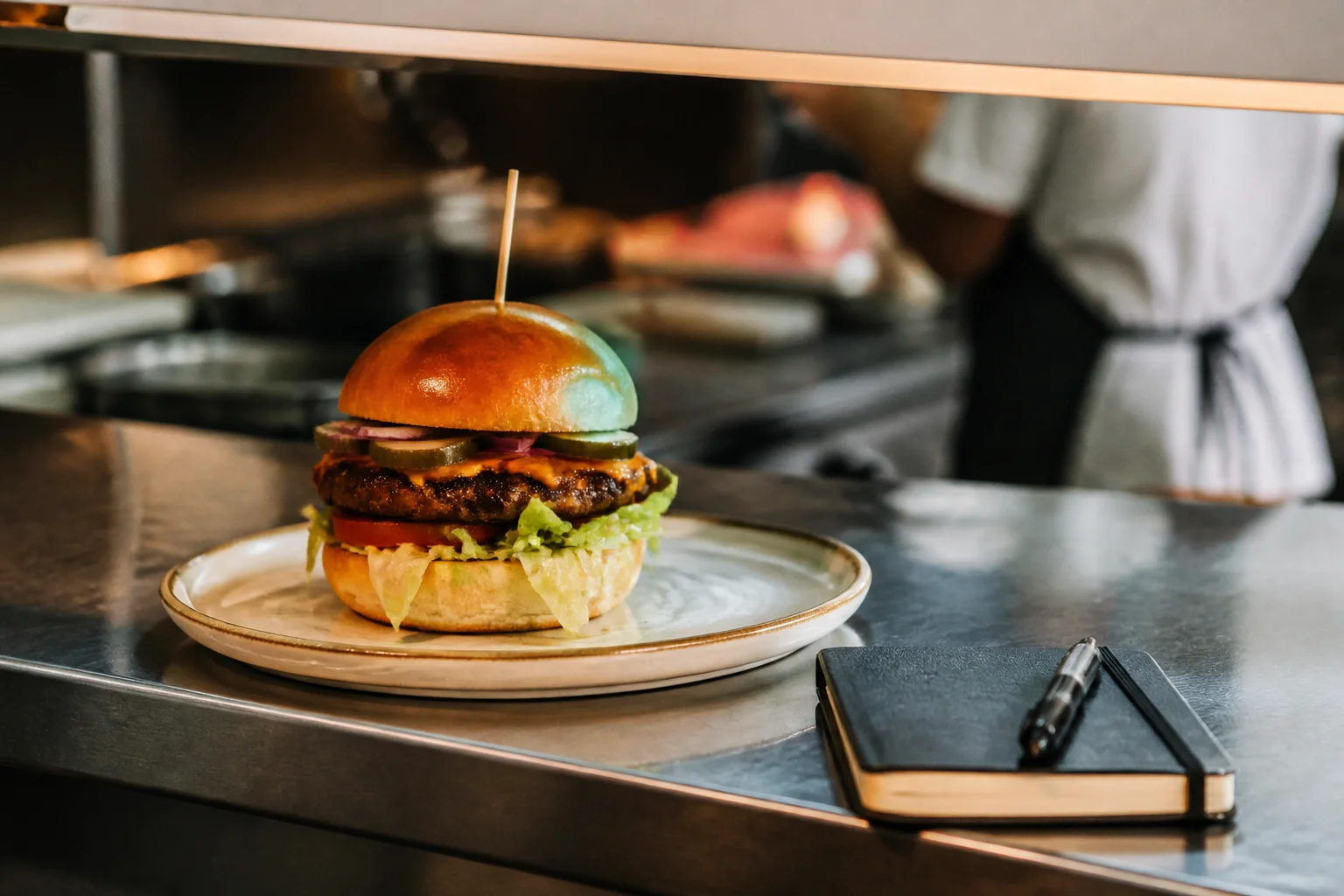
Food cost and gross margin: how to know what you really earn on a dish
By Javier Porras6 min read
Updated 13 September 2026.
El día que metiste en la carta el plato «al 28 %» porque lo leíste en un grupo de WhatsApp. El coste estaba bien. El PVP, más o menos. Y aun así a final de mes no entendías por qué no sobraba nada.
If you don't yet have cost per portion, do the step-by-step recipe costing first. Here we start from Carlos's burger: €3.95 cost and €14.50 selling price including VAT.
The mistake of looking only at the percentage
El food cost responde a una sola pregunta: qué parte de la venta neta se va en materia prima. El margen bruto responde a otra: cuántos euros quedan después de pagar esa materia prima.
La trampa habitual es quedarte con el % y olvidar los euros. Un plato al 22 % que deja 4 € puede financiar menos el local que otro al 32 % que deja 11 €. Empieza siempre por quitar el IVA. Si no, el % ya nace hinchado.
Step 1: take the price without VAT (and don't mix them)
Suppose you sell the burger for €14.50, VAT included. First, strip out the VAT:
Trampa del paso: usar el PVP con IVA en el denominador. Parece que el food cost es más bajo. No lo es. Estás dividiendo coste neto entre una venta que incluye dinero de Hacienda.
That is the net revenue you should run the calculations on.
Step 2: calculate the dish food cost
Food cost shows what percentage of net sales goes to paying for the dish's ingredients:
That means roughly 30% of net sales goes to ingredients. Is that good or bad? We can't answer yet. Because a percentage on its own doesn't tell the whole story.
Trampa del paso: fijar el 28 % como techo sagrado y subir precio sin mirar si el cliente lo aguanta o si el plato deja euros de verdad. Acción: escribe el % junto al margen en euros en la misma línea.
Step 3: gross margin in euros
The burger leaves a gross margin of €9.23 per unit sold. But be careful: those €9.23 are not yet clean profit. From that come wages, social security, rent, electricity, gas, admin, insurance, software, maintenance, cleaning products, bank fees, breakages and the rest of the business costs.
Recipe costing doesn't tell you everything you earn, but it does tell you how much each dish contributes towards paying for the rest of the business. And without that figure, you're making decisions in the dark.
Trampa del paso: celebrar el margen unitario y olvidar el volumen. 9,23 € × 80 ventas no es lo mismo que 9,23 € × 500. Acción: multiplica margen × unidades del último mes cerrado antes de pelearte con el precio.
Price incl. VAT
14,50 €
Price excl. VAT
13,18 €
Cost per portion
3,95 €
Food cost
≈30 %
Gross margin
9,23 €
Where the method breaks (and the case that breaks the average)
Si buscas un food cost del 28 % con 3,95 € de coste: 3,95 ÷ 0,28 = 14,11 € sin IVA → × 1,10 ≈ 15,52 € con IVA. Puedes poner 15,50 € o 15,90 €. La fórmula no es una orden divina.
Caso: dos platos. El A tiene food cost del 22 % y deja 5,10 €; vende 90 al mes → unos 459 € de margen de producto. El B tiene food cost del 31 % y deja 9,23 €; vende 500 → unos 4.615 €. El «peor» % paga más alquiler.
Ilustración propia con el margen de la hamburguesa de la serie (9,23 €) y un contraste de volumen. No es un ranking de mercado.
También debes valorar, además del %:
- Food cost
- Margin in euros
- Sales volume
- Prep time
- Waste generated
- Operational difficulty
- Positioning
- Price the guest will accept
El método se rompe cuando el coste de escandallo no es el real de cocina, cuando mezclas IVA, o cuando optimizas un plato que apenas se vende. Ahí el % es cosmética.
What dish food cost doesn't fix
No arregla un alquiler imposible, una plantilla sobredimensionada ni un ticket medio que no sostiene la estructura. Tampoco sustituye contrastar teórico y real en almacén.
Sirve para decidir precio, quitar o empujar platos y detectar si un «bestseller» te deja céntimos. Para el hueco papel vs cocina, sigue con theoretical vs actual cost. Para decidir qué queda en carta, how to design a more profitable menu.
Desde Tipi te ayudamos a ver el % y los euros juntos, plato a plato. No te prometemos un food cost mágico: le ponemos números a lo que ya vendes.
Si tienes el % pero no sabes si te deja euros de verdad, dínoslo y te decimos por dónde empezar.
If something new comes up on this, you'll read it here before anywhere else.
Got food cost and still don't know what the dish leaves you?
Con Tipi ves coste, % y margen en euros sin pelearte con el Excel. Dínoslo y te decimos por dónde empezar.
Sources
- Ejemplo de hamburguesa (3,95 € de coste, 14,50 € PVP con IVA al 10 %): elaboración propia de Tipi en la serie de coste por plato. No es el dato de un local concreto.
- Tipo de IVA del 10 % en restauración: Agencia Tributaria, tipos impositivos en el IVA (consultar tabla vigente). El divisor 1,10 del ejemplo asume ese tipo; si tu plato lleva otro tipo, cambia el divisor.