
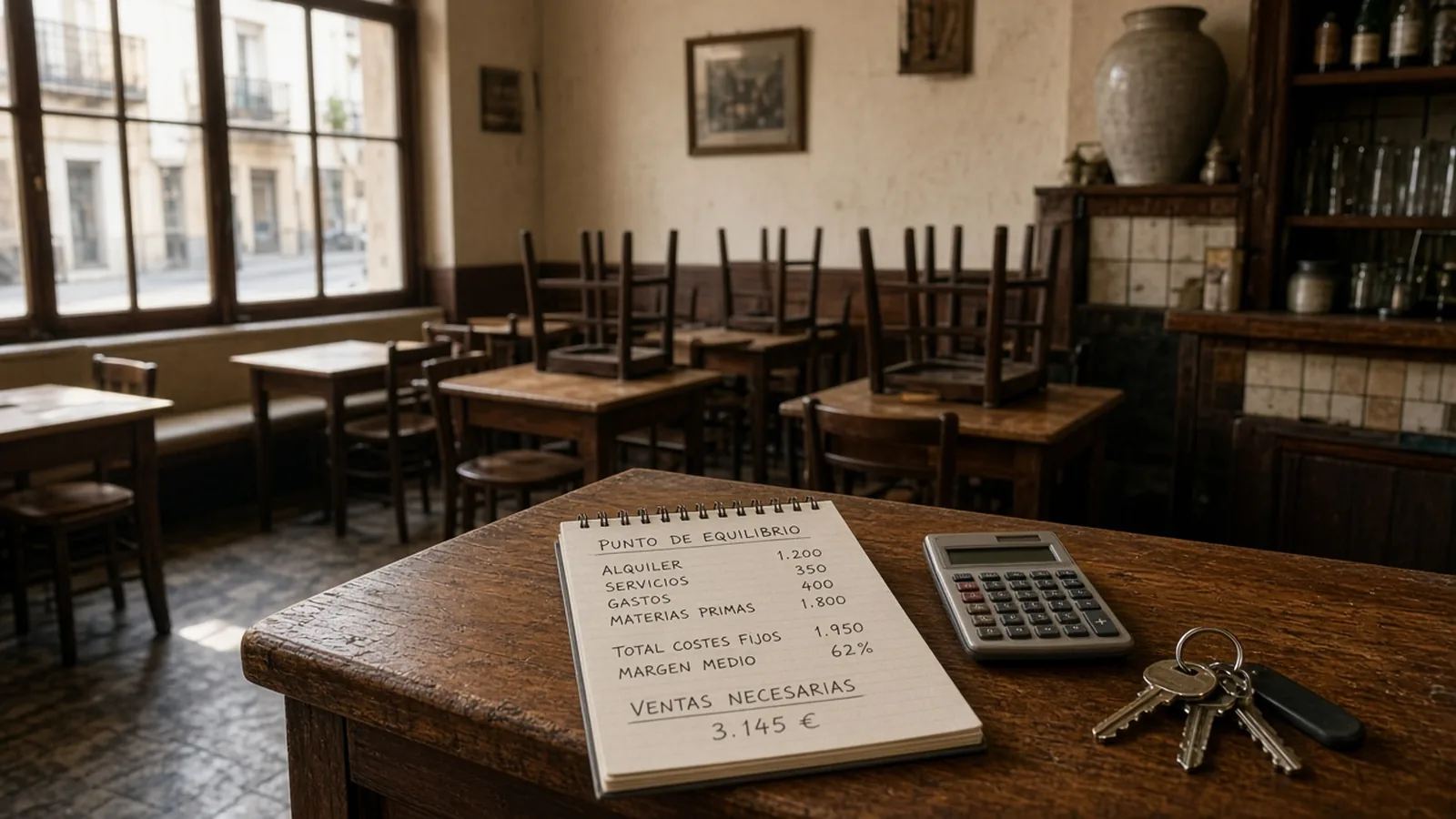
The first steps of your viability plan (and the mistake of starting with the premises)
By Samuel Carrillo8 min read
The fixed cost that sinks most restaurants is not raw materials — it is rent calculated badly: industry rule of thumb says it should not exceed 8–10% of expected sales, and many people sign before they know whether that sales figure is realistic. Before you look for premises you need a viability plan with four numbers of your own: concept, market, costs and break-even. This is the second step of the guide, and the first with a calculator.
Published 8 September 2026. Second chapter of the “From idea to business” guide. If you still haven’t done the first step, start there.
The premises you fell for (and signed without doing the numbers)
You saw it on a Tuesday. Good street, good price, the landlord in a hurry to close.
You called that same afternoon. You signed that same week.
And only afterwards, with the lease already signed, did you sit down to work out how much you had to sell every day to pay for it. The number did not fit, and there was no way back.
The most expensive mistake: choosing the premises before you have a viability plan
It is not an exception; it is the most repeated pattern in the sector. The usual diagnosis agrees: the failure is rarely the cooking or the location itself, but decisions taken in the wrong order.
Premises come fourth, not first. Before that come the concept, the market and the numbers that say whether that concept holds in that market.
It is the same pattern we covered in the first chapter: six in ten restaurants do not last a year, almost always because these numbers are calculated after signing, not before.
Step 1: concept and average ticket, in one sentence
If you cannot summarise your business in one sentence with an average ticket inside it, you do not yet have a concept: you have an idea.
“Traditional tapas bar, average ticket €12” is a concept. “A place with a good vibe” is not.
You do not invent the average ticket: you take it from what similar businesses charge in your area, not in the Instagram city you like most.
Step 2: how many people already sell what you sell
We already flagged this in the first chapter: knowing the market means having counted, not intuited.
Count similar businesses within a ten-minute walk. Note their average ticket, their opening hours and how many people walk in on a normal Tuesday, not a Saturday.
If that count comes out at zero competitors, be suspicious: there may be no demand, not a golden gap.
Step 3: split your costs into fixed and variable
Fixed costs are what you pay whether a customer walks in or not:
- Rent.
- Permanent staff (payroll and social security).
- Utilities: electricity, water, gas.
- Insurance and accountancy.
Variable costs rise and fall with sales:
- Raw materials.
- Casual or extra staff.
- Card terminal fees.
A warning from the sector itself: poorly planned staffing can push labour costs above 45% of sales, and that is what turns a full premises into a business that makes no money. The line between fixed and variable is not always clear (a Saturday cover waiter is variable; the same waiter on a permanent contract is fixed), which is exactly why it is worth writing it down, not calculating it from memory.
Step 4: calculate your break-even point
With those two numbers you can already calculate how much you need to sell each month not to lose money.
That result is your first real number. Everything you sell above it is profit. Everything below it, you put in yourself.
A worked example: the 60 m² tapas bar
Tipi’s own estimate for a 60 m² tapas bar — not a market figure.
| Item | Amount |
|---|---|
| Rent | €900/month |
| Permanent staff, utilities, insurance and accountancy | €4,700/month |
| Total fixed costs | €5,600/month |
| Variable costs (raw materials + casual staff) | 40% of sales |
Break-even: €5,600 ÷ (1 − 0.40) = €9,333 a month.
With an average ticket of €12, that is about 778 covers a month, 26 a day. And rent of €900 on that €9,333 is 9.6%, inside the 8–10% rule.
If the same premises cost €1,400 instead of €900, break-even would rise to €10,167. Those extra €500 of rent are not €500 more to sell: divided by the margin, they are €833 more sales needed every month, forever. And that rent no longer meets the rule: it becomes 13.8% of the sales you need.
The five calculations before you view a single premises
- Write your concept in one sentence with the average ticket included.
- Count similar businesses in your area and note their average ticket.
- List your estimated fixed costs one by one, without rounding down.
- Calculate your break-even with the formula above.
- Divide the rent you are looking at by that break-even. If it goes over 10%, find another premises or cut your fixed costs.
Before you copy these numbers into your own plan
The 40% variable costs and €4,700 fixed costs in our example are Tipi’s own estimate for a small bar: your city, your staffing and your concept change those numbers, sometimes a lot. The same concept in central Madrid and in a provincial capital can have double the rent and a very similar average ticket, and that changes the whole break-even.
Nor is there a single “normal” fixed-cost figure: it varies so much between a neighbourhood bar and a set-menu restaurant that any generic reference is only a starting point. The 8–10% rent rule does show up consistently across several industry sources, but the rest of the percentages change depending on who you ask.
The next step is still open: once you know how much you need to sell, how do you know whether your area can deliver those covers? That is searching for premises with data, and it is the next chapter of this guide.
Until the next piece of news that might help the sector.
Sources
- InfoHoreca, "60% of restaurants close before a year: the hidden mistakes ruining Spanish hospitality", 22 May 2026, with data from consultancy Linkers (rent rule and labour cost).
- Hostelería de Madrid, "Costs of a hospitality business", December 2025: agrees rent should not exceed 10% of annual sales.
- Tipi’s own work: break-even formula and the worked example with figures.