
Food waste in hospitality: one week logging what you throw shows how much you lose (and why it isn't always theft)
By Samuel Carrillo9 min read
Published 15 October 2026.
«I more or less know what I throw»
You see it every night. You know bread is left over on Mondays and that Thursday's fish, if it doesn't sell on Friday, goes out.
You see the big stuff. The small stuff that repeats, you don't: the extra trim, the sauce that went too far, the set-menu portions nobody ordered.
Nobody knows how much they throw until they write it down. The bin is emptied every night and leaves no trace.
A client of ours couldn't get food cost down. First they did inventory and food cost moved from 46% to 42%. When they measured how much went in the bin, they understood the rest.
What counts as waste in a restaurant?
Waste is every product you buy that never reaches the table as a paid dish. It comes from three places:
- Yield waste. What goes when you clean, butcher or cook: sirloin fat, skin, the water meat releases. It's expected and lives on the recipe card.
- Operational waste. What you throw without planning: what spoils, leftovers, the plate that comes back, the fry that burns on the pass.
- Unexplained gap. What's left when you subtract the first two. That includes unlogged comps, delivery notes that don't match and, yes, theft.
The problem is the order. If you don't measure the first two, everything missing falls into the third, and a badly measured yield looks like someone walked off with it.
How to measure hospitality waste: the bin test
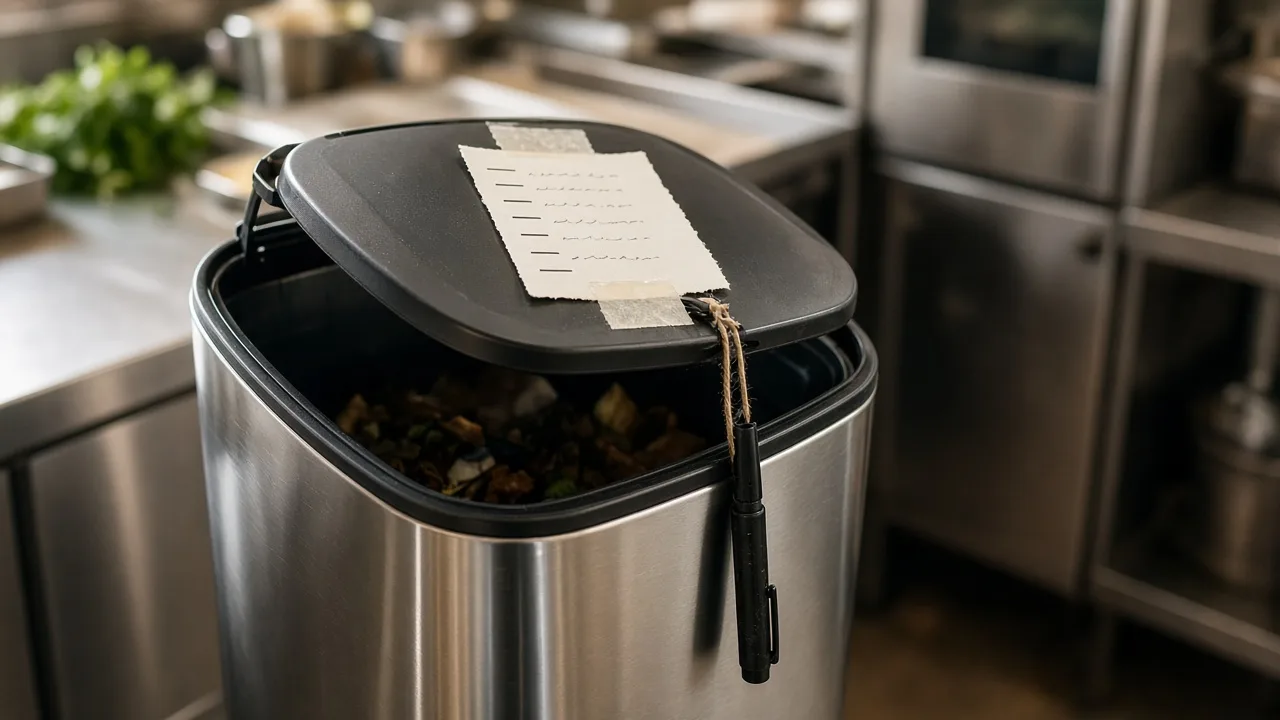
A sheet taped to the bin lid and a marker on a string. Seven days in a row.
Every time something goes in the bin, whoever throws it logs three things:
- What it is. «Sirloin trim», not «meat».
- How much. Weighed if there's a scale nearby, by eye if not. A rough number beats none.
- Why. Trim, expired, leftover, returned from the plate, burned.
On Sunday, each line times the latest delivery-note price, ex-VAT.
Before you tape the sheet, the catch: the first week will come out higher than you think, and your team will assume you're hunting blame.
Say it before you start: you log what, not who. If the sheet becomes a list of accused people, by day three nobody fills it in.
What the bin never sees
What you over-portion never reaches the bin. If the card says 200 grams and 240 leave the pass, those 40 grams are eaten by the guest and only show up in inventory as missing product. Same as the free beer for a friend.
That's why the bin doesn't replace the count: it completes it. If you still don't get the gap between what should be in the walk-in and what is there, this method finds it by counting only the 20 or 30 references that weigh most.
What's left after you subtract the sheet is the only gap that deserves an awkward conversation.
From inventory to the bin: €400 a week
It's the same client as the inventory article: the one who thought they ordered too much and, once they counted, saw food cost fall from 46% to 42%.
The gap was still there. So they taped the sheet to the bin.
The first week came out at €400 thrown away. Per month, about €1,600.
That was 7% of their sales: money leaving through the bin that no recipe card had fully counted.
Per week
€400
Per month
€1,600
Of sales
7%
Bin amounts and food-cost % are the client's, told anonymously. The invented week below only teaches the line-by-line maths.
One week of bin, converted to euros (teaching example)
Invented week to teach the maths: a restaurant with about €25,000 monthly sales ex-VAT and round delivery-note prices. Not the client case above.
| What was logged | In euros |
|---|---|
| Cooked octopus past date, 1.8 kg | €50.40 |
| Sirloin trim when cleaning, 1.3 kg | €33.80 |
| What came back on plates, about 5 kg | €15.00 |
| Set-menu leftover, 6 portions | €10.80 |
| Yesterday's bread, 4 kg | €9.60 |
| Spoiled veg in the walk-in, 3 kg | €6.00 |
| Expired mise en place, 1.5 kg | €6.00 |
| Pass mistakes, 4 portions | €3.60 |
| Week total | €135.20 |
That's about €7,000 a year.
The card only allowed for €15.60 a week: the 600 grams of trim it expected for the sirloin. The rest, about €6,200 a year, wasn't in any number.
On €300,000 of annual sales, that's two points of food cost.
One product is 37% of the bin. The octopus isn't a kitchen problem, it's a purchasing one: it was ordered for a weekend that never came.
The sirloin isn't in the bin, it's on the card
The card said that of 4 kg of sirloin, 600 grams went in trim, 15%. The sheet says 1.3 kg, more than 32%.
At €26/kg, a 200-gram clean portion doesn't cost €6.12, as the card says. It costs €7.70.
In inventory, that money shows up as «sirloin missing», and it's exactly what gets blamed on the supplier or the team. Nothing is missing: it stayed on the cutting board.
How much waste is normal in a restaurant?
We haven't found any published, reliable figure for restaurants in Spain. Distrust anyone who gives you a universal percentage.
Normal is what your card says. If it expects 15% trim and your kitchen gets 32%, the problem isn't that you throw a lot: it's that the card doesn't describe your kitchen.
What you do with each bin
- Yield: fix the card. Pick the three products you trim most. Weigh raw, clean the way your kitchen cleans, weigh usable. Three times on different days, keep the average. If the dish has no card, here's how to build the recipe costing from scratch.
- Operations: change the order or the prep. If a product repeats on the sheet, you're buying or producing too much. Less quantity, more often.
- What comes back from the plate: check the portion. If a dish comes back half-eaten again and again, either the portion is big or the dish isn't liked. Both cost money.
- What's left after: now you look. First portioning on the pass, then comps, then delivery notes. People are the last thing you look at.
How far one week of sheet goes
One week isn't a year. October isn't like August. Repeat the test when you change the menu or the season.
Eye-weight lies. Without a scale, the sheet is for seeing what repeats, not for balancing to the cent.
The law calls waste fewer things than you do. Law 1/2025 on prevention of food loss and waste defines it as «the part of food intended for human consumption that ends up discarded as waste». Sirloin fat doesn't count; on your P&L, it does.
And it doesn't force what you've been told. Some outlets have published that every bar must have a prevention plan since April 2026. Article 6 exempts premises up to 1,300 m² of sales area, unless sites under the same tax ID add up to more, and adds that «micro-enterprises are excluded from the obligations referred to in the preceding paragraphs of this article».
What article 8 does require of all hospitality is letting the guest take uneaten food without charging for it, except single-use plastic packaging, and noting it on the menu. Some legal bulletins extend the micro-enterprise exemption here; the Official Gazette does not.
Run the test this week. If Sunday you get a figure and don't know where half of it comes from, tell us and we'll say where to start.
And when you add up the sheet, do it sitting down.
Don't know where half the bin comes from?
Tell us what came out on your sheet: we'll help separate yield, operations and what's really missing.
From Tipi we help you see waste in euros, not only as a percentage.
Sources
- Law 1/2025 of 1 April on prevention of food loss and waste, Official Gazette 2 April 2025, articles 3, 6 and 8.
- El Español, new obligations for bars and restaurants under Law 1/2025, 9 May 2026.
- Reading of the micro-enterprise exemption extended to the whole law: Primera Lectura Ediciones regulatory bulletin, April 2025.
- Client case: Tipi advisory, told anonymously. Food cost and bin amounts are the client's.
- Teaching-week example, sirloin yield and conversion to euros: Tipi's own work.